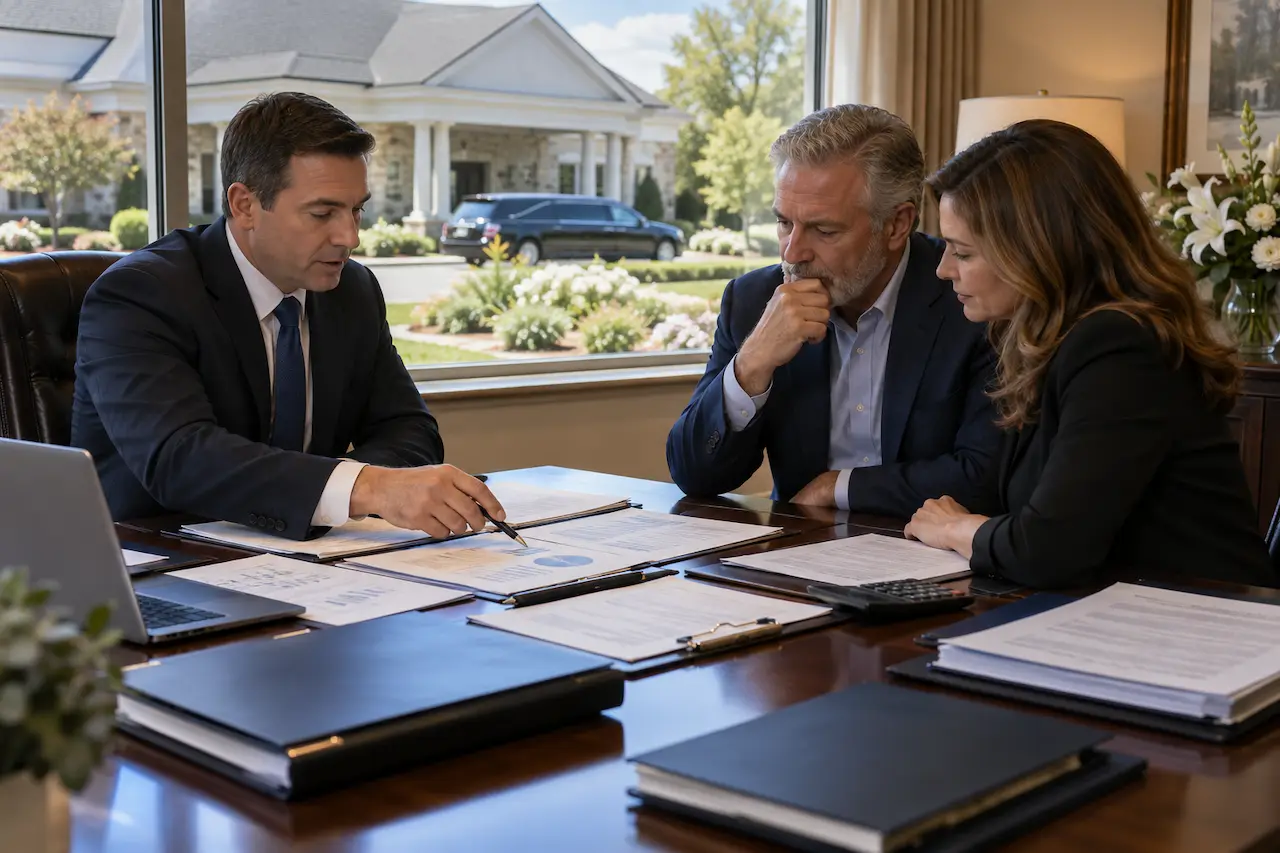
Buying an existing funeral home can be an effective way to enter the funeral service industry, expand an established business, or take over a family-owned operation. However, finding a promising property and agreeing on a purchase price are only the beginning.
Before approving financing, banks need to understand whether the business can support its debt, whether the buyer is financially prepared, and whether the proposed transaction makes sense.
A strong funeral home acquisition checklist bank lenders can review should cover three essential areas: the buyer, the funeral home being acquired, and the structure of the transaction.
Preparing these items before submitting a loan application can help you identify problems early, avoid unnecessary delays, and approach lenders with greater confidence.
1. Prepare Your Personal Financial Documents
Banks evaluate the buyer alongside the business. Even a profitable funeral home may present a financing challenge if the buyer lacks sufficient liquidity, has significant existing debt, or cannot document the required equity contribution.
Prepare the following documents before approaching a lender:
- Three years of personal federal income tax returns, including applicable schedules.
- A current personal financial statement listing assets, liabilities, and net worth.
- Recent bank and investment account statements.
- Documentation of available funds for the down payment and closing costs.
- A schedule of existing loans, monthly debt payments, and other financial obligations.
- A resume outlining your management experience and relevant industry background.
Why this matters: Banks need to verify that you can contribute the required equity, manage your financial obligations, and maintain adequate reserves after closing.
Do not assume that the money needed for a down payment is your only cash requirement. Legal fees, third-party reports, insurance, initial operating expenses, and unexpected repairs can increase your total funding needs.
Keep records showing where your funds originated. If some of your equity comes from selling an asset, receiving an investment distribution, or another legitimate source, retain the supporting documentation.
2. Collect Three Years of the Funeral Home’s Financial Records
Historical financial performance is one of the most important parts of funeral home acquisition financing.
Banks want evidence that the business has consistently generated enough cash to cover operating expenses and the proposed loan payments. Revenue alone does not demonstrate repayment ability.
Request the following from the seller:
- Three years of business federal tax returns.
- Year-to-date profit and loss statement.
- Current balance sheet.
- Historical cash flow information.
- Business debt schedule.
- Revenue breakdown by service type.
- Detailed operating expenses, including payroll and owner compensation.
- Information about unusual or nonrecurring expenses.
Ask your accountant to reconcile the tax returns with the financial statements. Significant differences should be explained before the lender begins underwriting.
Understand the Business’s True Cash Flow
Suppose a funeral home reports $1.5 million in annual revenue. That figure may look attractive, but it does not tell you how much money remains after payroll, merchandise, insurance, utilities, maintenance, and other operating expenses.
Banks examine sustainable earnings and the adjustments needed to estimate cash flow under new ownership.
Seller-proposed add-backs deserve particular attention. Personal expenses, unusual legal costs, or certain nonrecurring expenses may qualify for adjustments, but lenders will not automatically accept every adjustment.
Practical tip: Ask the seller for supporting records for every material add-back. Build your financing assumptions around earnings the lender can verify, not simply the seller’s advertised cash flow.
For additional guidance, read How to Read a Funeral Home Financial Statement Before You Buy.
3. Review Funeral Home Call Volume and Revenue Trends
Funeral homes have business characteristics that lenders must understand beyond standard financial statements.
Annual call volume helps explain how many cases the business handles and whether its operating activity is stable. However, the number of calls alone does not establish profitability.
Request at least three years of available call volume records, including year-to-date results. Where possible, separate the figures by service type, such as traditional funerals, cremations, and direct cremations.
Investigate the following questions:
- Has annual call volume increased, declined, or remained relatively stable?
- Has average revenue per call changed?
- Are higher revenues being offset by increased operating costs?
- Is the business losing market share to local competitors?
- Does the seller have evidence explaining significant changes in demand?
- Are revenue trends consistent with the tax returns and profit and loss statements?
A decline in call volume is not automatically a deal-breaker. However, you should understand its cause and determine whether the business can still support the proposed debt.
Avoid relying on aggressive growth projections to justify a purchase price that historical performance cannot support.
4. Calculate Debt Service Coverage Before Making an Offer

Debt service coverage ratio (DSCR) measures whether a business generates sufficient cash flow to meet its required debt payments.
A common starting point for commercial underwriting is a DSCR of 1.25x, although actual requirements vary by lender, loan program, transaction structure, and risk profile.
The calculation is:
DSCR = Cash Flow Available for Debt Service ÷ Annual Debt Service
For example, assume the funeral home generates $300,000 in lender-accepted annual cash flow and the proposed financing requires $240,000 in annual principal and interest payments.
DSCR = $300,000 ÷ $240,000 = 1.25x
In this simplified example, the business generates $1.25 for every $1.00 of annual debt service.
The important distinction is that lenders determine which cash flow figure is acceptable for underwriting. Seller-reported profit is not necessarily the same as lender-accepted cash flow.
Before committing to the purchase, ask your financing provider to model the proposed loan payment against verified earnings.
If coverage is insufficient, potential solutions may include negotiating a lower purchase price, increasing the equity contribution, restructuring the transaction, or considering a different financing option.
5. Document Your Management Experience and Transition Plan
Banks need confidence that the buyer can operate the funeral home successfully after the seller exits.
Relevant experience may include funeral service management, business ownership, financial oversight, staff supervision, or managing a comparable service business.
Prepare a resume and a brief explanation of how your background supports the acquisition.
If you are a first-time funeral home owner, explain how you will address any gaps in your experience.
Your transition plan should identify:
- Who will manage daily operations after closing.
- Whether the existing funeral director or key employees will remain.
- How licensing and regulatory requirements will be satisfied.
- How employees, suppliers, and existing customer relationships will be managed.
- Whether the seller will provide temporary transition assistance.
- How payroll, vendor payments, and service continuity will be maintained.
Where applicable, confirm state-specific licensing and ownership requirements with the appropriate regulatory authorities.
A practical transition plan is more persuasive than a general promise to grow the business because it shows how you intend to protect the funeral home’s existing operations.
6. Review the Purchase Price, Valuation, and Deal Structure
The seller’s asking price is not necessarily the value a bank will recognize for financing.
Before finalizing your offer, understand what you are buying and how the purchase price is allocated.
Your review should cover:
- Business goodwill and established customer relationships.
- Real estate, if included.
- Equipment, furniture, and vehicles.
- Inventory and other business assets.
- Existing liabilities and obligations.
- Any working capital required at closing.
- The proposed allocation of the purchase price among assets.
Goodwill can represent a substantial portion of a funeral home’s value. This matters because financing programs differ in how they treat business goodwill, real estate, and other assets.
An SBA 7(a) loan may finance eligible acquisition costs, including goodwill, subject to applicable program rules and lender approval. Conventional commercial lenders may take a different approach to intangible assets.
Ask for an independent valuation when appropriate, and ensure that the proposed purchase price is supported by the business’s financial performance.
Also, clarify whether the transaction involves an asset purchase or an equity purchase. The legal, tax, liability, and financing implications can differ.
For a broader explanation of how lenders evaluate purchase prices, read How Funeral Home Valuations Are Calculated: EBITDA Multiples Explained.
7. Evaluate Real Estate, Equipment, and Environmental Risks
If the acquisition includes a funeral home building, the lender may require an appraisal, property inspection, and environmental assessment.
These requirements depend on the transaction and financing program.
Review the following:
- Current property ownership and title information.
- Building condition and estimated repair costs.
- Zoning and permitted funeral service uses.
- Real estate appraisal requirements.
- Equipment condition and replacement needs.
- Vehicle titles and outstanding liens.
- Environmental assessment requirements.
- Existing leases, if the property is not included in the purchase.
Environmental due diligence deserves special attention when the property includes a crematory or other specialized facilities.
If the building is leased, review the remaining lease term, renewal options, rent increases, assignment provisions, and the landlord’s consent requirements.
A short or uncertain lease can create problems if the business needs a stable location to generate revenue and repay a long-term loan.
Identify major repairs and property-related expenses before finalizing your financing assumptions. A business that appears affordable at the asking price may require substantially more capital if significant improvements are necessary.
8. Verify Pre-Need Contracts, Liabilities, and Regulatory Compliance
Pre-need arrangements can create future service obligations and may involve trust funds, insurance products, or other arrangements governed by state law.
Do not treat pre-need balances as ordinary cash available to the buyer.
Ask qualified legal and accounting professionals to review:
- Existing pre-need contracts and associated obligations.
- Applicable trust balances and records.
- Insurance-funded arrangements, where relevant.
- Refund, cancellation, and transfer requirements.
- Outstanding litigation, tax liabilities, and creditor claims.
- Employee compensation and benefit obligations.
- Licenses, permits, and regulatory compliance.
- Contracts that must be assigned or renegotiated.
The treatment of pre-need contracts depends on the arrangement and applicable law. Confirm how the obligations will transfer before closing.
Your attorney should also review the purchase agreement for representations, warranties, indemnification provisions, and appropriate conditions for closing.
Unresolved liabilities can affect both the value of the acquisition and the lender’s willingness to finance it.
9. Prepare a Complete Loan Application Package
Once the buyer’s financial information and the target business records are organized, prepare the acquisition package.
A typical package includes:
| Document | What the Bank Uses It For |
| Personal tax returns | Verifies personal income and financial history |
| Personal financial statement | Evaluates assets, liabilities, and liquidity |
| Business tax returns | Reviews historical financial performance |
| Current profit and loss statement | Measures recent operating results |
| Current balance sheet | Reviews assets, liabilities, and financial position |
| Call volume history | Evaluates operating trends |
| Purchase agreement or letter of intent | Establishes the proposed transaction terms |
| Buyer resume and transition plan | Assesses management capability |
| Sources and uses of funds | Explains how the acquisition will be funded |
| Valuation and property information | Supports the purchase price and collateral review |
| Business plan and projections, if required | Explains the operating strategy and repayment assumptions |
Your lender may request additional documents based on the loan program, business structure, and transaction complexity.
You can also review the Funeral Home Loan Documents Checklist for a more detailed preparation guide.
For assistance organizing your application, visit the Funeral Home Loan Application page.
10. Choose the Right Acquisition Financing Structure
The financing structure can affect your required equity, repayment schedule, collateral requirements, and closing timeline.
Two common options are SBA 7(a) financing and conventional commercial loans.
SBA 7(a) financing: May be suitable for eligible funeral home acquisitions involving goodwill, business assets, and potentially real estate. Equity injection, guarantees, repayment terms, and other requirements depend on current SBA rules and lender underwriting.
Conventional commercial financing: May suit buyers whose financial profile, transaction size, collateral, and business performance align with a bank’s commercial lending criteria. Down payment and loan terms vary by lender.
Do not choose a loan solely because it advertises a lower rate or a smaller down payment. Compare the complete transaction, including fees, repayment obligations, collateral, guarantees, and available working capital.
Read SBA vs Conventional Funeral Home Loan: 2026 Comparison to understand the main differences.
Common Mistakes That Can Delay Funeral Home Acquisition Financing
Even a promising acquisition can encounter financing problems if important issues are overlooked.
Avoid these mistakes:
- Making an offer before understanding affordability: Estimate debt service and the total project cost before committing to a purchase.
- Accepting unverified seller add-backs: Require documentation and allow the lender to determine which adjustments qualify.
- Ignoring declining call volume: Investigate operating trends instead of assuming future growth will solve the problem.
- Underestimating working capital: Preserve adequate funds for payroll, insurance, supplies, and unexpected expenses.
- Overlooking pre-need obligations: Have qualified professionals review the contracts and related liabilities.
- Submitting incomplete documents: Organize records early and respond promptly to lender requests.
- Assuming financing approval is guaranteed: Obtain clear guidance on underwriting conditions and avoid treating preliminary discussions as final approval.
The goal is not simply to assemble paperwork. It is to demonstrate that the acquisition is financially sustainable, operationally practical, and appropriately structured.
Frequently Asked Questions
What do banks look for when financing a funeral home acquisition?
Banks generally assess the buyer’s credit and financial strength, available equity, the funeral home’s historical cash flow, debt service coverage, management experience, purchase price, and transaction structure. They may also require valuations, property assessments, and additional due diligence.
How much down payment do I need to buy a funeral home?
The required contribution depends on the financing program and transaction. SBA 7(a) acquisitions commonly require at least a 10% equity injection under applicable rules, calculated against the total project cost rather than just the purchase price. Conventional commercial financing may require a larger contribution. Confirm the current requirements with your lender.
Can I buy a funeral home without prior ownership experience?
Yes, first-time buyers may qualify. Lenders will still evaluate whether the buyer can manage the business. Relevant industry experience, a qualified management team, an operational transition plan, and strong financial preparation can help support the application.
Can an SBA loan finance funeral home goodwill?
An eligible SBA 7(a) loan can finance goodwill as part of a qualifying acquisition. The lender must evaluate the transaction, repayment ability, and applicable SBA requirements. The treatment of individual costs depends on the deal structure and program rules.
What DSCR do banks typically require for a funeral home loan?
A DSCR of 1.25x is a common underwriting benchmark, but it is not a universal requirement. Actual thresholds vary by lender, financing program, and transaction risk. Ask the lender to calculate coverage using its accepted cash flow figure.
What documents should I request from the seller before buying a funeral home?
Start with three years of business tax returns, current financial statements, historical call volume, debt schedules, owner compensation details, pre-need information, and property records when applicable. Your accountant, attorney, and lender may request further documentation during due diligence.
How long does funeral home acquisition financing take?
The timeline depends on the completeness of the application, lender review, valuation requirements, environmental assessments, legal due diligence, and transaction complexity. Some acquisitions take several months from an accepted offer to closing. Ask your lender for a transaction-specific timeline.
Can a seller note help finance a funeral home acquisition?
A seller note may help structure an acquisition, subject to lender approval and applicable financing rules. Under certain SBA 7(a) requirements, a seller note can count toward the required equity injection only if specific conditions are met, including full standby and limits on the amount counted. Do not assume that every seller note qualifies.
Get Prepared Before You Approach a Bank
A successful funeral home acquisition starts with a clear understanding of the business, the buyer’s financial position, and the debt the operation can realistically support.
Use this checklist to organize your records, verify historical cash flow, investigate potential liabilities, and prepare a credible transition plan. Addressing these issues early can help you identify financing obstacles before they threaten the transaction.
If you are preparing to purchase a funeral home, contact FuneralHomeLoan.com to discuss your acquisition and explore financing options suited to your transaction.
The right preparation can help you approach lenders with a stronger application, clearer expectations, and a more informed plan for ownership.