Buying your first funeral home is a major professional and financial milestone. You may have years of experience serving families, managing operations, or working as a licensed funeral director, but purchasing an established business introduces new responsibilities.
One of the biggest concerns is whether you can qualify for financing without previously owning a funeral home.
The good news is that first-time ownership does not automatically disqualify you from getting a funeral home loan. Lenders evaluate your financial background, relevant experience, available down payment, and the business’s ability to repay the proposed loan.
A first time funeral home buyer loan may be available through SBA-backed or conventional financing, depending on the acquisition structure and your qualifications.
Understanding what banks expect before you approach a seller can help you avoid expensive mistakes and prepare a stronger application.
Can You Get a Funeral Home Loan as a First-Time Buyer?
Yes. Banks regularly consider first-time funeral home buyers, particularly those with relevant funeral service experience, management skills, and sufficient financial resources.
However, lenders need evidence that you can successfully operate the funeral home after the current owner leaves.
For example, a licensed funeral director who has managed employees, coordinated services, and handled daily operations may demonstrate valuable experience even without previous ownership.
A buyer coming from another industry might also qualify, but would generally need a stronger operational plan and qualified funeral service personnel.
The objective is to establish that you understand the business, can manage its responsibilities, and have a realistic financing strategy.
For buyers exploring their first acquisition, our First-Time Funeral Home Buyer Financing Guide explains financing options designed for new owners.
What Do Lenders Look for in First-Time Funeral Home Buyers?
Banks assess both the buyer and the funeral home being purchased. A financially strong buyer cannot necessarily make an unprofitable acquisition financeable, and a profitable funeral home may still be difficult to purchase with an unprepared borrower.
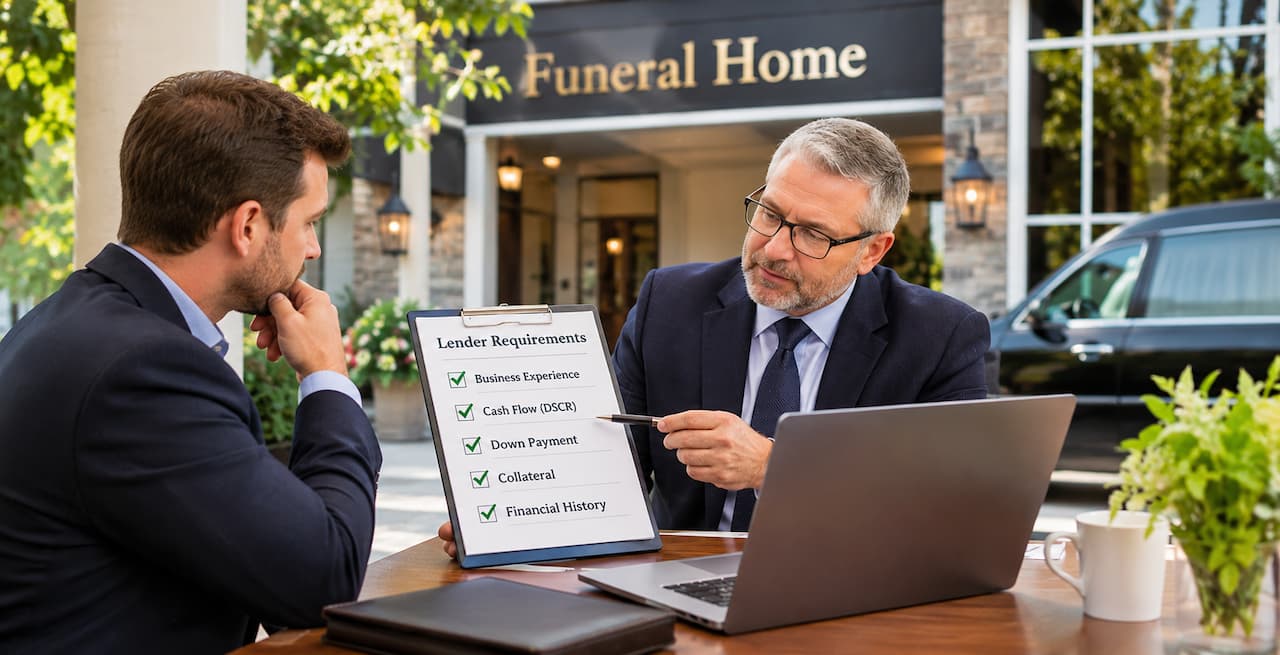
Understanding the following requirements can help you determine where you stand.
1. Personal Credit History and Financial Responsibility
Your credit history provides lenders with insight into how you manage financial obligations.
Banks commonly review payment history, outstanding debt, credit utilization, past delinquencies, and major financial issues such as unresolved tax liens.
Although some lenders prefer credit scores around 680 or higher, this is not a universal SBA qualification threshold. Actual requirements vary by institution, program, and transaction.
If your credit is less than ideal, take these steps before applying:
- Review your credit reports and resolve inaccuracies.
- Reduce unnecessary debt where financially practical.
- Prepare explanations and supporting documentation for past credit problems.
Lenders are looking for responsible financial management, not simply the highest possible credit score.
2. Relevant Funeral Industry or Management Experience
Experience is especially important when purchasing a funeral home for the first time. A funeral home requires specialized knowledge involving family arrangements, staffing, regulatory requirements, facility management, and financial oversight.
Lenders may consider experience in funeral directing, embalming, operations management, business administration, or supervising employees.
If you do not have direct industry experience, demonstrate how you will manage those responsibilities.
For example, retaining an experienced licensed funeral director after closing may help address concerns about operational continuity. The strongest approach is to document your experience, identify qualified personnel, and explain who will handle critical responsibilities.
3. Available Down Payment and Cash Reserves
Most first-time buyers need to contribute their own capital toward the acquisition.
For many qualifying SBA 7(a) complete ownership changes, a minimum equity injection of 10% of total project cost is generally required, although lender-specific requirements and deal circumstances may affect the amount.
Conventional financing may require 20% to 30% or more, depending on the lender and collateral.
Consider an illustrative acquisition:
| Financial component | Amount |
| Funeral home purchase price | $1,200,000 |
| Additional eligible project costs | $100,000 |
| Total project cost | $1,300,000 |
| Illustrative 10% equity contribution | $130,000 |
| Remaining financing need | $1,170,000 |
These figures are examples, not a loan offer or approval estimate. Actual equity requirements and eligible costs depend on the transaction.
Banks also want to see sufficient liquidity after closing to handle unexpected expenses.
Our detailed guide on How Much Down Payment You Need to Buy a Funeral Home explains how lenders evaluate equity contributions and available funds.
4. Historical Cash Flow and Debt Repayment Ability
One of the most important lending considerations is whether the funeral home generates enough cash to support the proposed loan.
Banks commonly review three years of financial statements and tax returns, normalized earnings, operating expenses, and existing business debt.
They may calculate a debt service coverage ratio (DSCR) to understand the relationship between available cash flow and required debt payments.
For example:
- Annual cash flow available for debt service: $250,000
- Annual required debt payments: $200,000
- DSCR: 1.25x
This means the business generates $1.25 of available cash flow for every $1 of debt service.
A 1.25x ratio is a common lender benchmark, but underwriting definitions and minimum requirements vary.
A funeral home generating substantial revenue might still struggle to qualify if payroll, operating expenses, maintenance, and other obligations consume most of its cash flow.
Practical advice: Focus on verifiable historical earnings rather than assuming immediate revenue growth after acquisition.
5. Funeral Home Call Volume and Revenue Stability
Funeral homes have operating characteristics that make their financing different from many other small businesses.
Banks review annual call volume, revenue per service, burial and cremation mix, and changes in community demand.
A funeral home serving 180 families annually may have a different financial profile from one serving 75, even when both operate in similar markets.
Lenders also consider whether business performance depends heavily on the seller’s personal relationships.
If calls are declining, buyers should understand why before proceeding. Changes in local competition, cremation preferences, pricing, or demographics can influence revenue.
For further insight into how banks evaluate funeral service businesses, read How Banks Look at a Funeral Home Loan.
Which Financing Option Is Best for a First-Time Funeral Home Buyer?
The appropriate loan depends on your available equity, purchase price, business cash flow, and whether real estate is included.
Two of the most relevant options are SBA 7(a) financing and conventional commercial lending.
SBA 7(a) Funeral Home Loans
SBA 7(a) financing is often suitable for first-time funeral home buyers because it may cover multiple components of an eligible acquisition.
These can include business goodwill, equipment, real estate, and working capital.
The program currently has a standard maximum loan amount of $5 million. Repayment terms depend on how the proceeds are used and applicable program rules.
Small Business Administration+1
An important benefit is the ability to finance goodwill, which can represent a substantial portion of an established funeral home’s value.
Learn more about our SBA 7(a) Funeral Home Loans and how they may support qualifying acquisitions.
Conventional Commercial Funeral Home Loans

Conventional financing may be appropriate when a funeral home acquisition includes substantial real estate or other valuable collateral.
These loans often require larger equity contributions, but they can offer different repayment structures and underwriting terms.
Conventional options may be particularly attractive to financially established buyers with significant liquidity.
Our Commercial Funeral Home Loan Options explain how traditional bank financing works for funeral home businesses.
What Documents Should First-Time Buyers Prepare?
Incomplete financial documentation is a common reason lending reviews take longer than expected.
Before submitting a formal loan application, organize the records that help lenders assess your financial position and the proposed acquisition.
Typical requirements include:
- Personal financial statement and recent personal tax returns.
- Business tax returns and financial statements, generally covering three years.
- Documentation showing available equity and its source.
- Professional résumé outlining relevant experience.
- Proposed purchase agreement or letter of intent.
- Funeral home call volume records and an operating transition plan.
Additional documentation may include property information, equipment valuations, business debt schedules, and preneed obligations.
You do not necessarily need every document for an initial lender conversation. However, preparing the essential information early can help identify financing obstacles before they delay the transaction.
What If You Have Never Owned or Managed a Funeral Home?
Limited ownership experience does not mean your financing options are automatically closed.
However, you must address the operational risks that concern lenders.
A buyer without funeral industry experience should identify the licensed professionals who will manage services, explain staffing arrangements, and demonstrate knowledge of the applicable state regulations.
A written transition plan should cover employee retention, management responsibilities, seller involvement, and continuity of service.
For instance, negotiating a reasonable transition period with the existing owner can provide operational support while you become familiar with the business.
Lenders may view a credible management team more favorably than unsupported claims that you can learn everything after closing.
Can Seller Financing Help First-Time Buyers?
Seller financing can sometimes help bridge a funding gap in a funeral home acquisition.
Under this arrangement, the seller agrees to receive a portion of the purchase price through payments made after closing.
However, banks carefully evaluate seller notes.
Payment terms, lien positions, subordination requirements, and the effect on cash flow can influence whether the arrangement is acceptable.
For certain SBA transactions, a qualifying seller note may count toward part of the required equity injection, subject to applicable restrictions. It should never be assumed that seller financing automatically replaces a buyer’s cash contribution.
Our article on How Seller Notes Are Viewed by Banks in Funeral Home Transactions explains the considerations involved.
Common Mistakes That Can Delay Your First Funeral Home Loan
First-time buyers sometimes focus heavily on finding the right property while overlooking the financing challenges that emerge during underwriting.
Several mistakes deserve attention.
Agreeing to a Purchase Price Before Reviewing Cash Flow
An attractive business or established community reputation does not guarantee sufficient earnings to support the proposed debt.
Review actual financial performance before making major commitments.
Using All Available Savings for the Down Payment
A funeral home may require immediate maintenance, payroll support, vehicle replacement, or other unexpected expenditures.
Retaining reasonable cash reserves can help protect the business after closing.
Ignoring Preneed Obligations
Preneed arrangements can create important contractual, trust, and regulatory obligations.
Buyers should work with qualified advisors to understand the treatment of these accounts and liabilities before purchasing the business.
Overlooking Ownership Transition Risks
The current owner’s departure may affect employees, referral relationships, and customer confidence.
A clear transition strategy reduces uncertainty for buyers and lenders alike.
How to Prepare for Your First Funeral Home Acquisition Loan
Preparation starts before submitting a formal application.
A practical approach is to establish your available budget, understand the target funeral home’s financial history, and speak with an experienced lender before finalizing the acquisition terms.
A funeral home-specific lending professional can help evaluate whether the proposed financing structure aligns with documented cash flow, required equity, and your management background.
Our Funeral Home Acquisition LoanSolutions help buyers understand SBA and conventional financing options before making major purchasing commitments.
You should also involve a qualified accountant and attorney experienced in business acquisitions to review financial statements, purchase agreements, and regulatory obligations.
Frequently Asked Questions
Can I qualify for a funeral home loan without previous ownership experience?
Yes. Previous funeral home ownership is not universally required. Lenders evaluate relevant work experience, management qualifications, personal finances, available equity, and the business’s ability to repay the loan.
What credit score do I need for my first time funeral home loan?
Credit requirements vary among lenders. Some prefer scores around 680 or higher, but there is no single score that guarantees approval. Banks also consider debt history, liquidity, experience, and business cash flow.
How much money do I need to buy my first funeral home?
Many qualifying SBA 7(a) acquisitions require at least a 10% equity injection based on total project cost. Conventional lenders may require larger contributions. Buyers should also budget for transaction costs and working capital.
Can I use an SBA loan to purchase an existing funeral home?
Yes. SBA 7(a) loans can finance eligible ownership changes and may cover goodwill, equipment, real estate, and qualifying working capital. Approval depends on SBA eligibility, lender underwriting, and transaction structure.
Can I purchase a funeral home if I am not a licensed funeral director?
Potentially, depending on state ownership and operating rules. Some jurisdictions impose specific licensing or ownership restrictions. You may need qualified licensed personnel to manage regulated funeral services. Confirm the requirements in the state where the business operates.
Will lenders finance a funeral home with declining call volume?
Possibly. Lenders will investigate the reasons for declining volume and whether the remaining cash flow can support loan repayments. A credible explanation and defensible financial plan are important.
How long does approval take for a first time funeral home buyer?
Timelines depend on financial documentation, underwriting, valuations, real estate reviews, regulatory requirements, and transaction complexity. Some acquisitions can take several months from an accepted offer to closing.
What happens if my funeral home loan application is denied?
Ask the lender which factors prevented approval. Depending on the circumstances, you may need to improve your credit profile, contribute more equity, strengthen management arrangements, renegotiate the purchase price, or consider a different financing structure.
Get Expert Guidance Before Buying Your First Funeral Home
Purchasing your first funeral home is achievable when the business fundamentals, financing structure, and buyer qualifications align.
At Funeral Home Loan, we understand the concerns first-time buyers face, from down payment requirements and lender expectations to goodwill valuation and ownership transitions.
With more than 20 years of specialized funeral home lending experience, Matt Manske works directly with federally insured banks to help qualified buyers evaluate financing options.
You can discuss your proposed acquisition confidentially, understand potential financing requirements, and identify the information needed for the next step.
Speak directly with a funeral home lending specialist before committing to your purchase.
Contact Matt Manske to Discuss Your Funeral Home Loan
Call: 913-343-2357
Direct bank financing. No brokers. No upfront fees.