
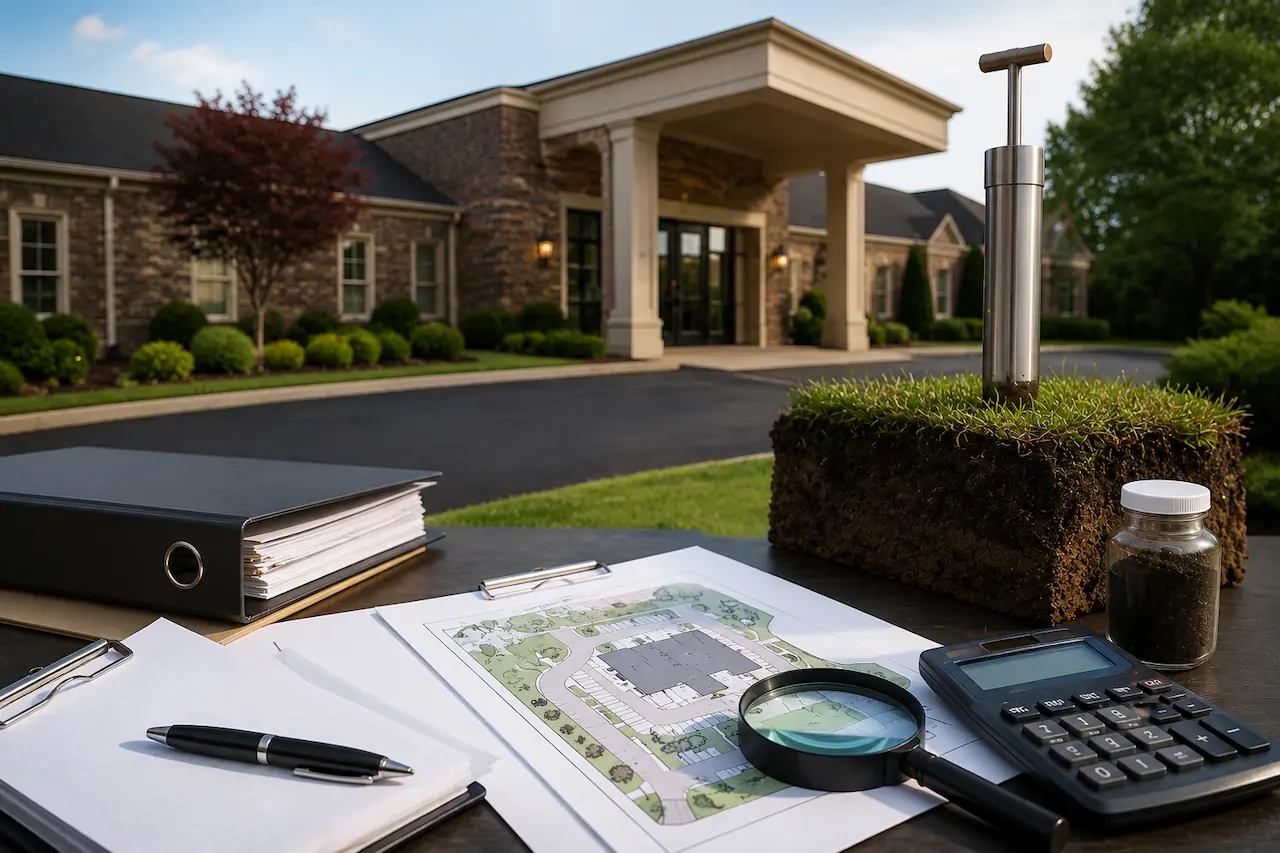
Most funeral home buyers budget for an appraisal. Almost no budget for an Environmental Phase I Assessment, and then it shows up as a surprise line item, or a surprise delay, three weeks before closing.
Here is the reason it catches people off guard: a funeral home does not look like an environmental risk. There is no smokestack, no chemical storage yard, no obvious red flag on a drive-by. But funeral homes have two things almost every lender’s environmental checklist flags automatically. They handle embalming fluid, which contains formaldehyde. And many of them, especially older buildings, still have or once had an underground heating oil tank. Both are enough to trigger a mandatory review before a bank will fund the real estate.
This guide explains what an Environmental Phase I Assessment actually is, why it is close to unavoidable for funeral home property, what it costs, how long it takes, and what happens if the report comes back with a problem. The goal is simple: know this is coming before your lender tells you, so it never becomes the thing that stalls your closing.
What Is an Environmental Phase I Assessment?
A Phase I Environmental Site Assessment, often shortened to Phase I ESA, is a professional review of a property’s environmental condition. It follows a standard set by ASTM (E1527) and is recognized by the EPA as the accepted method for identifying environmental risk before a real estate transaction closes.
A licensed environmental consultant does three things:
- Records review. Historical aerial photos, fire insurance maps, old business directories, and state and federal environmental databases are checked for anything tied to the property or land nearby.
- Site inspection. A consultant walks the property looking for storage tanks, stained soil, drains, chemical storage areas, and signs of past industrial or automotive use on adjacent lots.
- Interviews and reports. The consultant talks to current owners or staff, then writes a report that either clears the property or flags what are called Recognized Environmental Conditions, or RECs.
One detail trips people up every time: a Phase I ESA does not include soil or groundwater testing. No samples are collected. It is a paper trail and a walk-through, not a lab test.
If Phase I turns up a REC, a follow-up Phase II ESA is what brings in actual sampling. That distinction matters because it changes both the cost and the timeline, which we cover below.
Why This Applies to Funeral Homes Specifically
Buyers often assume environmental review is for gas stations, dry cleaners, and factories. Funeral homes get pulled in for two reasons that are specific to the industry, plus a third that depends on the building’s age.
Embalming Fluid and Formaldehyde
Embalming fluid is a regulated chemical. Formaldehyde is classified by OSHA as a hazardous substance, and the EPA has it under ongoing review through the Toxic Substances Control Act. A preparation room where embalming has occurred for years is exactly the kind of use a lender’s environmental checklist is built to catch. It does not mean there is contamination. It means the use itself is enough to trigger the review.
Underground Storage Tanks
Older funeral homes, particularly those converted from residential buildings or built before the 1980s, commonly used underground heating oil tanks. Many of these tanks were simply abandoned in place rather than removed when properties switched to gas or electric heat.
An underground storage tank, active or abandoned, is one of the most common Recognized Environmental Conditions found in any commercial Phase I ESA, and funeral home properties are no exception.
A real example makes this concrete. When a Kansas municipality tried to redevelop a former funeral home site, the Phase I ESA turned up a previously unidentified 1,000-gallon heating oil underground storage tank, the documented potential for embalming fluid discharge tied to the site’s funeral home history, and possible unreported contamination from a petroleum tank removed next door.
None of those issues were visible from the street. All three came from the records review and site walk that a Phase I is designed to catch.
Building Age and Prior Use
A funeral home that occupies a converted Victorian home, a former hotel, or a building that sat on commercially zoned land before it became a funeral home carries the environmental history of every prior use.
If a gas station, dry cleaner, or auto shop ever operated on or near the parcel, that history follows the property into your Phase I report regardless of what the building is used for today.
Why Lenders Require It Before Funding
Environmental risk is not really about the funeral home business. It is about collateral. When a bank finances real estate, that property becomes the collateral securing the loan. If the site is later found to be contaminated, the value of that collateral can drop sharply, and the cost of cleanup can become the bank’s problem as much as the borrower’s.
SBA guidelines require environmental due diligence on real estate-secured loans above a certain threshold, and most conventional commercial lenders apply a similar standard even outside SBA financing. This is not a funeral-home-specific rule. It is a standard part of underwriting any owner-occupied commercial real estate purchase.
If your deal includes the building along with the business, expect this step. If you are considering leasing rather than buying, the way a lender treats the real estate changes significantly, and it is worth understanding how the real estate decision changes your financing before you commit to a structure.
What Happens If the Report Comes Back Clean
Most Phase I ESAs on operating funeral homes come back clean, meaning no Recognized Environmental Conditions are identified. When that happens, the report becomes part of your closing file, the lender checks the box, and the transaction moves forward on schedule.
This is the outcome in the large majority of cases, and it is worth remembering when the process feels like an obstacle. It is a formality far more often than it is a problem.
What Happens If the Report Flags a Recognized Environmental Condition
If the consultant identifies a REC, an old tank, a documented spill, contamination on a neighboring parcel, the deal does not automatically die. It does, however, branch into one of a few directions.
- Phase II ESA. The lender may require soil or groundwater sampling to determine whether the flagged condition represents actual contamination or just a documented historical risk. Many RECs turn out to be non-issues once tested.
- Remediation. If contamination is confirmed, a cleanup plan and cost estimate typically has to be built into the deal, sometimes with the seller covering some or all of the expense.
- Escrow holdback. Lenders sometimes allow closing to proceed with funds held back until remediation is complete or a No Further Action letter is issued by the state environmental agency.
- Renegotiation. Buyers use confirmed environmental issues as leverage to renegotiate price, especially when the seller was unaware of the condition.
None of these outcomes are unusual in commercial real estate. What matters is finding out early enough that your closing timeline has room to absorb it, rather than discovering it two weeks before your scheduled close.
Timeline and Cost
A standard Phase I ESA on a funeral home property typically takes one to three weeks from order to final report, depending on how quickly the consultant can access historical records and schedule the site visit.
Cost usually runs between $1,500 and $4,000 for a straightforward commercial property, though pricing varies by region, property size, and how much history needs to be researched.
If a Phase II becomes necessary, add another two to six weeks and a meaningfully higher cost, since it involves actual drilling, sampling, and lab analysis. This is exactly why ordering the Phase I early matters.
Waiting until underwriting is already underway to start the environmental review is one of the more avoidable ways a deal loses weeks it did not need to lose. Building this into your loan preparation checklist from the start keeps it from becoming a late surprise.
How to Keep This From Delaying Your Loan
A few habits separate buyers who sail through environmental review from buyers who watch their closing date slip.
- Order it the moment you have a signed letter of intent. Do not wait for the lender to ask. Most lenders will accept a Phase I ordered in parallel with underwriting rather than after it.
- Ask the seller about the building’s history up front. Prior uses, known tank removals, and any past environmental incidents should come out in due diligence conversations before the report does the finding for you.
- Request tank sweep records if the property is older. A documented tank removal with closure paperwork from the state resolves what would otherwise be an open question in the Phase I.
- Keep your consultant and lender in direct contact. Reports get flagged for follow-up questions or missing documentation more often than they get flagged for contamination. A direct line between consultant and underwriter closes that gap fast.
- Build a buffer into your timeline. Even a clean Phase I takes one to three weeks. Factor that into your document checklist and overall closing plan from day one.
The Bigger Picture
An Environmental Phase I Assessment is not a sign that something is wrong with the property you are buying. It is a standard, expected part of financing real estate that comes with a funeral home attached, the same way an appraisal or a title search is expected. How lenders evaluate the appraisal and how they evaluate the environmental report both feed into the same underwriting decision: is this collateral sound enough to lend against.
Buyers who understand this ahead of time, order the report early, and keep clean documentation on hand move through this step without friction. Buyers who find out about it from their lender in week four of underwriting are the ones who lose time they did not budget for.
Frequently Asked Questions
Does every funeral home purchase require a Phase I Environmental Assessment?
Most do, especially when the loan includes the real estate and involves SBA or conventional bank financing. Business-only transactions where the buyer is leasing the property, rather than purchasing it, may not require one, though some landlords request it independently.
Who pays for the Phase I ESA, the buyer or the seller?
This is negotiable and usually decided in the letter of intent or purchase agreement. In most transactions, the buyer orders and pays for it since the report protects the buyer and the buyer’s lender, but sellers sometimes cover the cost to keep the deal moving, particularly if they already suspect it will come back clean.
Can a funeral home fail a Phase I because of embalming activity alone?
Rarely, on its own. Routine, properly managed embalming fluid use is common in the industry and does not automatically produce a Recognized Environmental Condition. RECs typically come from evidence of improper disposal, staining, damaged storage, or documented spills, not from the presence of a preparation room.
What is the difference between a Phase I and a Phase II Environmental Site Assessment?
A Phase I is a records review and site inspection with no physical sampling. A Phase II is triggered only if the Phase I identifies a Recognized Environmental Condition, and it involves actual soil or groundwater testing to confirm whether contamination is present.
How long is a Phase I ESA valid for financing purposes?
Most lenders, including those following SBA guidelines, consider a Phase I ESA valid for about 180 days from the report date. If your closing is delayed beyond that window, expect the lender to request an updated report or a reliance letter from the original consultant.
Will an old underground storage tank automatically kill my loan?
Not automatically. An abandoned or active tank is flagged as a REC, which typically triggers further investigation rather than an outright decline. If the tank was properly closed with state documentation, or testing shows no leak occurred, most lenders will move forward once that paperwork is in the file.
Does the environmental report affect how much I can borrow?
Indirectly. The report itself does not set your loan amount, but an unresolved environmental issue can affect the appraised value of the real estate, and the real estate value is part of what determines your total financing structure on an acquisition.
Every funeral home real estate deal carries a slightly different environmental profile depending on the building’s age and history. If you are getting ready to buy, refinance, or expand, our team can walk you through what your specific property is likely to trigger and how to structure your SBA 7(a) loan or commercial funeral home loan so environmental due diligence never becomes a closing-day surprise. Check our current funeral home loan requirements to see what your lender will ask for from day one.


