 Skip to content

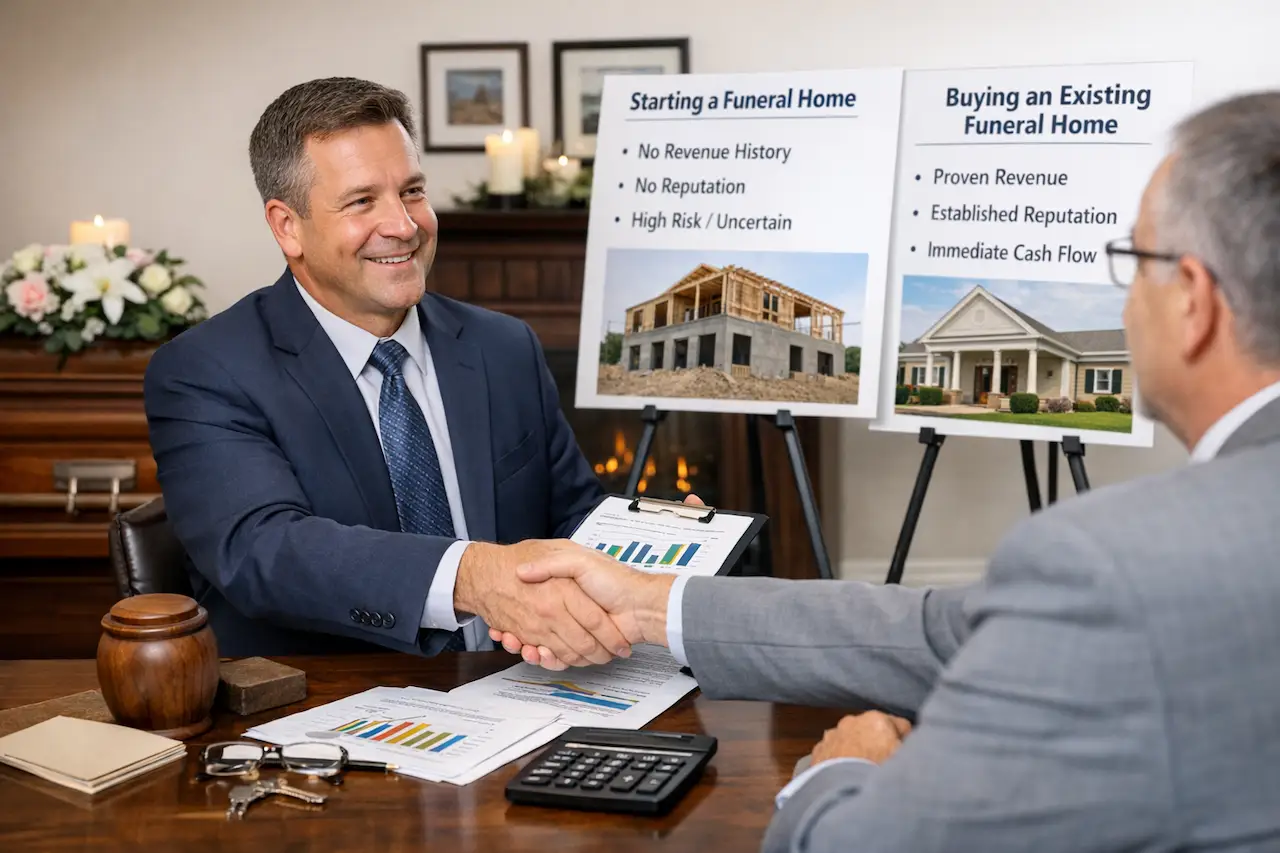
Every licensed director eventually asks the same question. Build something of my own, or buy what someone else built?
We have financed funeral home transitions for over twenty years, and the pattern is consistent: the overwhelming majority of successful ownership changes in this profession happen through acquisition, not startup. The reason is financing, and the gap is wider than most directors expect.
In this guide: what each path costs, why lenders treat them differently, when a startup does make sense, and how to decide.
The Short Answer
| Factor | Starting from scratch | Buying an existing firm |
| Upfront capital | Often $1M–$3M+ before first call | 10–30% down payment |
| Revenue at closing | $0 | Immediate |
| Bank financing | Difficult, often declined | Routine |
| SBA equity injection | 10% minimum, frequently 20–30% required | 10% minimum |
| Time to profitability | 3–7 years typical | Day one, if underwritten correctly |
| Primary risk | Will families come? | Will cash flow service the debt? |
| Community reputation | Built from zero | Transfers with the business |
The financing difference is not a preference. It is structural, and understanding why makes the decision easier.
Why Lenders Finance Cash Flow, Not Ideas
A bank underwrites a loan by answering one question: can this business repay it?
For an existing funeral home, the answer comes from evidence — three years of tax returns, documented call volume, a burial and cremation split, revenue per call, and a demonstrated margin. An underwriter can calculate debt service coverage from history and stress-test it.
For a startup, the answer comes from projections. There is no call volume to analyze, no revenue per call to verify, and no operating history to trend. The lender is being asked to underwrite a forecast.
That is why startup funeral home financing typically requires larger down payments, additional outside collateral, strong non-business income, and conservative structures — and why many lenders decline it entirely regardless of how experienced the applicant is.
What Starting a Funeral Home Actually Costs
The capital requirement surprises most directors, because the individual items are familiar but the total rarely gets assembled in one place.
- Real estate. Purchase or ground-up construction of a facility with chapel, arrangement rooms, prep room, and parking. In most markets this alone runs seven figures.
- Preparation room build-out. Ventilation, plumbing, drainage, and chemical storage to code — a specialized build, not a standard commercial fit-out.
- Crematory, if included. Retort, installation, permitting, and environmental compliance.
- Fleet. Hearse, lead car, and removal vehicle at minimum.
- Licensing and regulatory. Establishment license, inspections, and state-specific requirements.
- Working capital. Payroll, insurance, marketing, and operating costs through a multi-year ramp with minimal revenue.
That last item is the one that sinks startups. Community trust in this profession is generational. A new firm in an established market does not reach sustainable call volume in year one, and the working capital required to survive the ramp is routinely underestimated.
What Buying Costs and Why It Finances Better
An established funeral home brings five things a startup cannot manufacture:
Proven revenue. Historical financial statements a lender can verify and trend.
Documented call volume. The single metric underwriters look at first — often before credit. We explain why in how call volume affects funeral home loan approval.
Community standing. Families choose funeral homes through relationships built over decades. That standing transfers with the business.
Operating infrastructure. Trained staff, vendor relationships, established pricing, vehicles, and procedures already in place.
Pre-need relationships. A funded pre-need book represents future call volume, provided the trusts are compliant and documented.
Because all five are verifiable, a bank can underwrite the transaction on evidence. Down payments start at 10% for SBA 7(a) financing, and terms extend to 25 years when real estate is included.
Purchase pricing typically runs $500,000 to $7 million for single locations depending on call volume and real estate — our full breakdown is in how much it costs to buy a funeral home.
When a Startup Does Make Sense
We are not arguing that starting is never right. It works in specific conditions:
- An underserved market with no acquisition target. Growing communities without an established local firm.
- A cremation-focused model with low fixed costs. Substantially less capital-intensive than a full-service build.
- Substantial outside capital. Buyers who can self-fund the ramp without bank dependency.
- An existing operator expanding. A second location backed by an established firm’s cash flow underwrites very differently from a true startup — see multi-location funeral home financing.
The last case is worth emphasizing. If you already own a funeral home, adding a location is not a startup in the SBA’s eyes when structured correctly, and the equity requirements can be dramatically lower.
Financing Both Paths
For acquisitions, SBA 7(a) is usually the strongest fit. It permits goodwill financing, requires 10% equity injection, and amortizes up to 25 years with real estate. Conventional financing suits experienced operators with stronger liquidity. We compare them in SBA vs conventional funeral home loans.
For startups, SBA 7(a) also requires a minimum 10% equity injection, though lenders commonly ask for more given the absence of operating history. Expect additional collateral requirements and a longer, more documentation-heavy process.
Either path starts the same way — with a realistic assessment of what you can support. Our loan preparation guide and first-time funeral home buyer resources cover what to assemble.
Why Choose Us
We finance funeral home acquisitions and expansions directly through federally insured banks, and we will tell you honestly when a startup will not finance.
- Straight assessment of which path your situation supports
- Over 20 years financing funeral home transitions, including firsthand funeral service experience
- Direct bank relationships — no brokers, no upfront fees
- Structures built for goodwill-heavy acquisitions, not generic small business lending
- Guidance from first conversation through funding
Conclusion
Starting a funeral home costs more upfront, takes years to reach sustainable call volume, and finances poorly because lenders cannot underwrite a forecast. Buying an established firm delivers proven revenue, community standing, and infrastructure on day one, which is why banks fund acquisitions routinely and startups reluctantly. For most directors seeking ownership, acquisition is both the faster and the lower-risk path.
Call Matt directly at 913-343-2357 to talk through which path fits your situation.
Frequently Asked Questions
How much does it cost to start a funeral home?
Between real estate or construction, prep room build-out, vehicles, licensing, and working capital through a multi-year revenue ramp, most full-service startups require well over a million dollars before the business supports itself. A cremation-focused model with leased space costs substantially less but still requires meaningful working capital reserves.
Can I get an SBA loan to start a funeral home?
It is possible but considerably harder than financing an acquisition. SOP 50 10 8 requires a minimum 10% equity injection for startups, and lenders routinely ask for more, along with additional collateral and strong outside income. Many lenders decline startup death-care financing regardless of the applicant’s experience.
Is it easier to get a loan to buy a funeral home than to start one? Substantially. An existing firm provides verifiable financial history that lets an underwriter calculate debt service coverage from evidence rather than projections. That difference is the single largest factor in approval odds.
How long before a new funeral home is profitable?
Most reach sustainable call volume in three to seven years, depending on market density and how much community presence the founder already has. Families choose funeral homes through long-standing relationships, and building those relationships from zero takes time no marketing budget shortens reliably.
Should I buy a struggling funeral home and turn it around? Turnarounds are financeable but harder. Lenders underwrite historical cash flow, so a firm with declining call volume supports a smaller loan than its asking price suggests. If the decline has a fixable cause — an owner who disengaged, deferred facility investment — the deal can work with the right structure and a larger equity contribution.


