
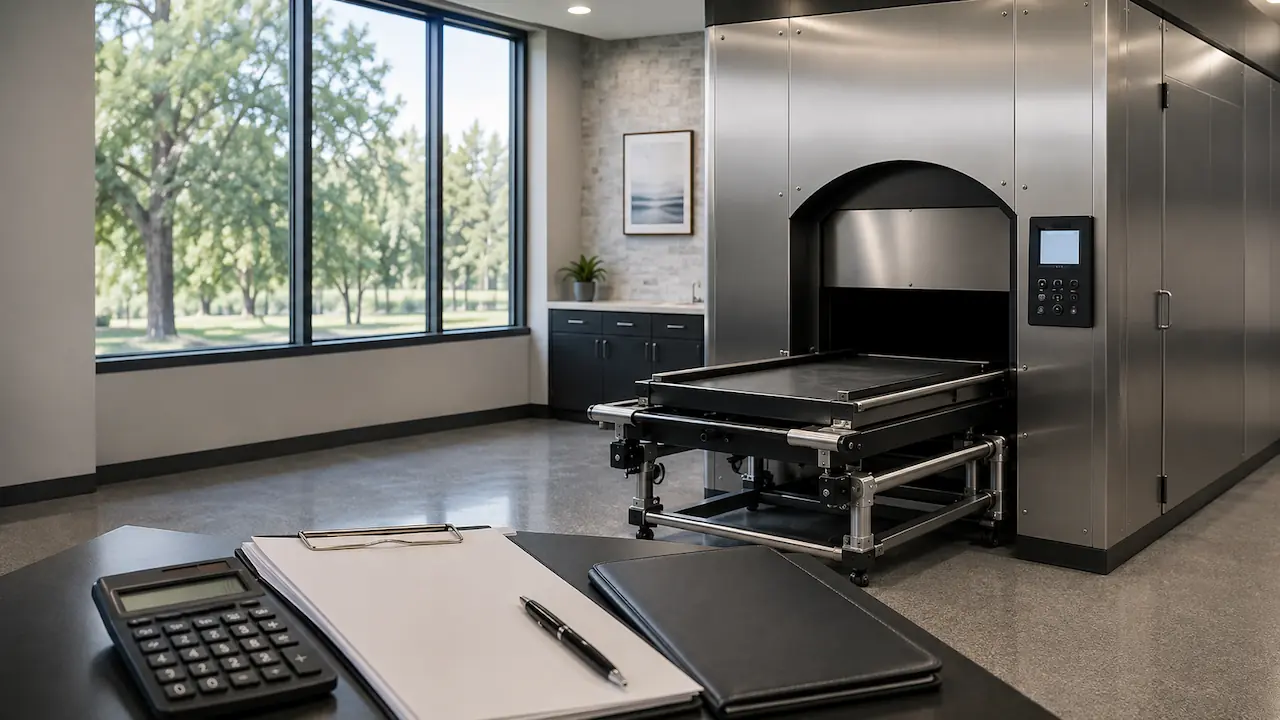
A retort is the single most expensive line item in almost every crematory project. Not the building, not the parking lot or not the chapel finishes. The retort plus everything required to install and run it usually consumes the largest share of the budget, and most funeral home owners underestimate this piece before they start calling lenders.
That underestimate causes real problems. Owners walk into a bank conversation expecting to discuss a $170,000 machine and leave the meeting realizing the actual project cost climbs closer to $400,000 once they factor in installation, permitting, and utility work By then, the loan structure they had in mind no longer fits the deal.
This guide breaks down what retort equipment actually costs in 2026, how funeral home owners finance it, what lenders want to see before they approve it, and the mistakes that slow deals down or sink them outright.
What Counts as “Retort Equipment” in a Financing Conversation
When a lender says “equipment,” a funeral home owner often hears “the machine.” Those are not the same thing. For financing purposes, retort equipment usually includes:
- The cremation chamber (retort) itself, gas-fired or electric
- The secondary combustion chamber and emissions control components
- The stack and venting system
- Loading and cooling systems
- Controls, PLC panels, and monitoring equipment
- Installation labor, including crane operators for setting the unit
- Gas and electrical contractor work to tie the unit into utilities
- Permitting, inspection, and commissioning costs tied directly to the equipment
A lender underwriting the deal wants to know which of these costs the loan will cover, because that decision changes which loan product fits and how the lender collateralizes the equipment.
How Much Does Crematory Retort Equipment Cost in 2026?
Prices vary by manufacturer, capacity, fuel type, and whether the unit is new or used. Here is a realistic breakdown for human cremation retorts:
| Equipment Tier | Retort Only | Full Installed Project |
| Entry-level imported unit | $15,000 – $50,000 | Higher risk, shorter lifespan, harder to finance |
| Mid-tier, UL-listed unit | $50,000 – $150,000 | $200,000 – $350,000 |
| Standard American-made retort | $150,000 – $200,000 | $300,000 – $500,000 |
| Premium high-volume system | $300,000+ | $500,000 – $650,000+ |
A few things drive that gap between “retort only” and “full project”:
- Delivery and rigging. Moving and setting a multi-ton chamber often requires a crane operator.
- Gas and electrical contractor work. Tying the unit into utilities isn’t a DIY job, and it isn’t optional.
- EPA and air quality permits. Emissions permitting varies significantly by state and can take months.
- Zoning and local approval. Some municipalities treat a new crematory as a conditional use, which adds time and cost before owners even order the equipment.
Most complete crematory equipment projects land in the $300,000 to $500,000 range once every piece is counted, not just the retort itself. A full crematorium build-out, including facility work beyond the equipment, can run considerably higher.
If you’re scoping the whole project rather than just the retort, our guide on what it costs to buy a funeral home in 2026 walks through how equipment costs fit into a larger acquisition budget.
Why Retort Financing Is Different From a Standard Equipment Loan
Retort equipment doesn’t behave like a delivery van or a piece of restaurant equipment on a lender’s balance sheet. A few things make it its own category:
It’s specialized collateral. There isn’t a deep resale market for used cremation retorts the way there is for, say, a forklift. That limits how much a lender will lend against the equipment’s value alone.
It’s regulated. Retorts require air quality permits, state crematory licensing, and often local zoning approval. A lender will want to see that these are in place, or a credible plan to get them, before funding.
It’s tied to revenue projections, not just resale value. Because collateral value is limited, lenders lean harder on projected call volume and cash flow to decide whether the business can service the debt. Lenders apply the same underwriting logic across funeral home lending generally, as we explain in more detail in our piece on how funeral home loan interest rates are actually set.
It’s often bundled into a larger project. Very few owners finance “just the retort.” Most retort purchases happen alongside a renovation, an acquisition, or a new facility build, which changes which loan product makes sense.
Financing Options for Retort Equipment
SBA 7(a) Loans
The SBA 7(a) program is the most common way funeral home owners finance retort equipment, particularly when the purchase is part of a larger acquisition or facility upgrade. It covers equipment, real estate, and working capital in a single loan, which matters because retort purchases rarely happen in isolation.
Key numbers for 2026:
- Maximum loan amount: up to $5 million
- Down payment (equity injection): typically 10%
- Terms: up to 10 years for equipment-only financing; up to 25 years when the equipment is bundled with real estate that makes up more than half the loan
- Rates: variable, based on Prime plus a lender spread, capped by the SBA
The longer term owners can secure when they bundle equipment with real estate is one of the biggest reasons they prefer SBA financing for retort purchases over a straight equipment loan.
A 10-year equipment-only term on a $400,000 retort project creates a meaningfully higher monthly payment than a 25-year blended term. You can see how this program works in more depth on our SBA 7(a) Funeral Home Loans page.
Commercial Equipment or Term Loans
For owners who already have real estate financed and just need to add or replace a retort, a standalone commercial loan secured by the equipment itself is often faster to close than SBA financing. Terms are usually shorter 5 to 10 years and down payment requirements can run higher, since the lender is relying more heavily on the equipment’s limited resale value as security.
Our Commercial Funeral Home Loans page covers how conventional financing compares to SBA options for this kind of purchase.
Equipment Vendor Financing
Some retort manufacturers offer in-house financing or lease-to-own arrangements. This can be convenient, but it’s worth comparing the total cost against a bank or SBA option before signing. Vendor financing sometimes carries a higher effective rate in exchange for a faster, simpler approval process.
Refinancing to Free Up Capital for Equipment
If a funeral home already owns its real estate and has built equity, refinancing the existing property loan can free up cash to fund a retort purchase or a full crematory build-out without taking on a completely separate loan.
This works particularly well for owners adding a crematory to an existing funeral home rather than starting a standalone crematory business. Details on how that process works are on our Refinancing for Funeral Homes page.
What Lenders Look at Before Approving Retort Financing
Lenders evaluating a retort purchase whether standalone or bundled into a larger project — tend to focus on the same handful of questions:
- Do you have permits in hand, or a credible path to them? A lender will not want to fund equipment that can’t legally be installed and operated yet.
- What does projected call volume support? If the retort is for a new crematory, the lender wants realistic case volume projections, not optimistic ones. If it’s replacing an aging unit, historical call volume from the existing operation carries more weight.
- Is the equipment new or used, and from a known manufacturer? Established brands with parts and service support are easier to underwrite than off-brand imported units, because resale value and reliability are both stronger.
- What’s the debt service coverage ratio after this new payment is added? This is the same core metric that decides most funeral home loan approvals across the board.
- What’s the down payment or equity contribution? Ten percent is standard on SBA-backed deals; commercial equipment loans sometimes require more given the limited resale market for retorts.
To see the full list of documentation and financial benchmarks lenders check across funeral home transactions generally, our Loan Requirements page is a useful companion to this article.
New vs. Used Retort Equipment: How It Changes Financing
Buying a used retort can cut the equipment cost significantly, but it changes the lending conversation. Lenders will typically ask for:
- Maintenance records and manufacturer inspection history
- Confirmation of remaining useful life, since SBA equipment terms are tied to the asset’s expected lifespan
- An independent inspection before closing, in some cases
A used unit with poor documentation is harder to finance than a new one with a full warranty, even if the used unit is cheaper upfront. If the loan term needs to match the equipment’s remaining life rather than a full 10-year SBA term, the monthly payment goes up, which affects how much cash flow cushion the business needs to carry.
A Realistic Financing Timeline
Retort equipment financing generally follows this sequence:
- Get quotes from two or three manufacturers, including installation and utility hookup estimates, not just the machine price.
- Confirm zoning and air quality permitting requirements with your state and local authorities before applying, since most lenders will ask.
- Decide whether the retort is standalone or part of a larger project — acquisition, renovation, or new build — because that determines which loan product fits.
- Apply with a lender who understands funeral home and crematory financing specifically, since general small business lenders often don’t know how to underwrite this kind of collateral.
- Expect underwriting to take several weeks longer than a standard equipment loan if permits or zoning approvals are still in progress, since the lender is often waiting on the same paperwork you are.
Common Mistakes Owners Make When Financing a Retort
Budgeting for the machine, not the project. The retort price tag is rarely the number that matters. Owners who go into lender conversations with only the equipment quote often have to restart the process once installation and permitting costs surface.
Assuming any equipment lender can handle it. General equipment finance companies often don’t understand crematory permitting timelines or the resale limitations on this kind of collateral, which can lead to unrealistic terms or last-minute denials.
Underestimating permitting timelines. Air quality permits in particular can take months in some states. Applying for financing before permitting is underway, or without a clear plan for it, is one of the most common reasons retort financing stalls.
Choosing the shortest available term to minimize interest. A shorter term raises the monthly payment and tightens debt service coverage, which can create cash flow strain in the early months of a new crematory when call volume is still ramping up.
Frequently Asked Questions
How much does it cost to install a cremation retort, not just buy one?
Installation, including crane rigging, gas and electrical contractor work, and permitting, typically adds $130,000 to $330,000 on top of the equipment price itself, bringing a full project to roughly $300,000 to $500,000 for a standard American-made unit.
Can you get an SBA loan for crematory equipment?
Yes. Borrowers can use SBA 7(a) loans to finance equipment, including retorts, either as a standalone equipment purchase or bundled with real estate and other project costs in a single loan.
What down payment is typically required to finance a retort?
On SBA-backed financing, 10% is standard. Commercial equipment loans secured only by the retort itself sometimes require a higher down payment because of the equipment’s limited resale market.
Is it cheaper to finance a used retort than a new one?
The equipment cost is usually lower, but financing terms are often shorter and less favorable, since lenders tie the loan term to the unit’s remaining useful life and want documented maintenance history before approving the deal.
How long does it take to get approved for retort equipment financing?
Timelines vary based on whether permits and zoning approvals are already in place. A straightforward equipment loan can close in a few weeks; a project still waiting on air quality or zoning approval can take considerably longer, since the lender is often underwriting around that same timeline.
Do lenders require the crematory to already have permits before approving financing?
Most lenders want to see permits in hand or a credible, documented path to obtaining them before funding. Financing a retort with no permitting plan in place is one of the more common reasons a deal gets delayed or declined.
What’s the difference between financing a retort as equipment versus as part of an SBA real estate loan?
Equipment-only SBA terms max out around 10 years. When the retort purchase is bundled with real estate that makes up more than half the loan, the term can extend up to 25 years, which significantly lowers the monthly payment.
Getting the Right Financing Structure From the Start
Retort equipment is expensive, specialized, and regulated in ways that most general business lenders aren’t equipped to underwrite. The owners who move through this process smoothly are the ones who price the entire project upfront, get permitting timelines nailed down early, and work with a lender who has actually financed crematory equipment before.
If you’re evaluating a retort purchase as part of a larger acquisition or expansion, our team at FuneralHomeLoan.com works through this exact structuring conversation with funeral home owners regularly. Schedule a free consultation to talk through your project and get a realistic financing structure before you go shopping for equipment quotes.


