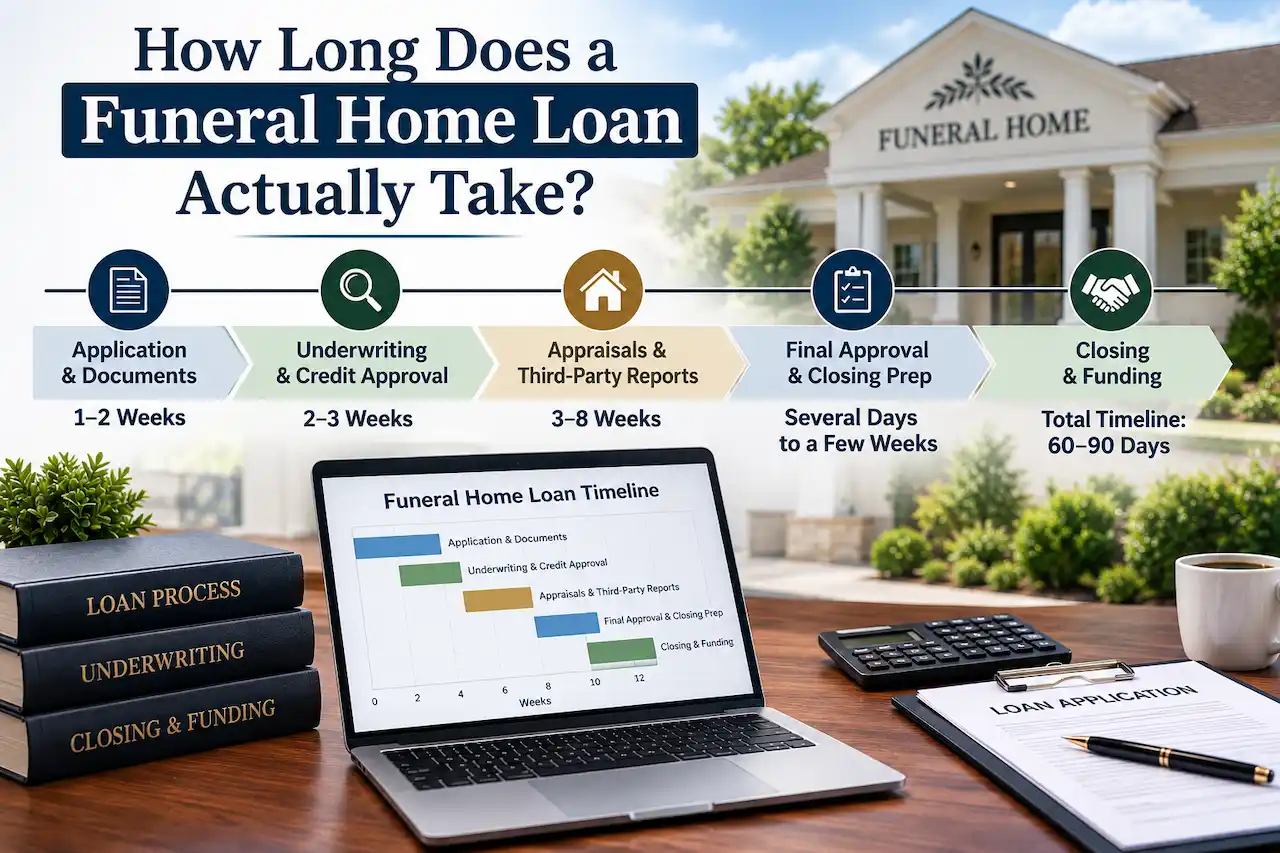
A funeral home loan can take several weeks to several months, depending on the financing program, borrower qualifications, required documents, property evaluations, and lender approval process. A straightforward transaction with complete financial records may progress more efficiently, while a complicated acquisition involving real estate, business goodwill, and multiple approval conditions can take considerably longer.
For funeral home buyers, the important question is not simply how quickly a bank can approve a loan. It is how much time is needed to move from initial financing discussions to a completed transaction.
A funeral home loan timeline generally includes initial preparation, application submission, underwriting, third-party evaluations, final loan conditions, and funding. Some stages can happen simultaneously, while others must be completed in sequence.
Understanding these differences helps buyers, owners, and sellers plan a realistic financing schedule without relying on an unrealistic closing promise.
How Long Does Funeral Home Financing Take From Start to Finish?
The total funeral home financing timeline depends on when the process begins and what the transaction requires.
A buyer who already has organized financial statements, documented equity, and a preliminary purchase agreement may be better prepared than someone who has not yet established their financing needs.
Similarly, purchasing an existing funeral home with commercial real estate can involve more documentation than financing a smaller equipment purchase.
The following table explains the major milestones.
| Financing Stage | Main Activities | What Affects the Timeline |
|---|---|---|
| Initial financing review | Review borrower qualifications and transaction goals | Financial readiness and complexity |
| Application preparation | Collect business and personal documentation | Missing or inconsistent records |
| Bank underwriting | Evaluate credit, cash flow, DSCR, and loan structure | Lender requirements and follow-up questions |
| Third-party evaluations | Complete required appraisals and valuations | Property access and outside providers |
| Final loan conditions | Resolve outstanding approval and documentation requirements | Legal, insurance, title, and financial conditions |
| Closing and funding | Sign documents and complete fund disbursement | Coordination among all parties |
These stages do not necessarily occur one after another. For example, lenders may initiate certain third-party evaluations while other underwriting activities continue.
The total period should be discussed with the lender based on the specific transaction rather than estimated by adding together separate stage durations.
When Does the Funeral Home Loan Timeline Actually Begin?
One of the biggest sources of confusion in funeral home financing is the starting point used to calculate the timeline.
Different buyers and lenders may refer to different milestones when discussing how long financing takes.
Initial Financing Discussion
An initial conversation with a lender helps determine whether a proposed acquisition, refinancing request, or expansion project appears suitable for further evaluation.
The buyer may not yet have a signed purchase agreement or complete financial package.
This stage is useful for understanding financing options, but it does not mean formal underwriting has started.
Signed Letter of Intent or Purchase Agreement
A signed letter of intent (LOI) may establish the preliminary terms of a funeral home acquisition.
However, signing an LOI does not automatically mean the buyer has completed the loan application or satisfied the lender’s documentation requirements.
Additional time may be needed to collect financial information, verify available equity, and finalize the financing structure.
Buyers should carefully distinguish the date an acquisition is proposed from the date a complete application is accepted for underwriting.
Complete Loan Application
The formal underwriting process generally begins once the lender has enough information to evaluate the financing request.
A complete application may include borrower financial records, business tax returns, operating statements, acquisition documents, and supporting information.
If additional documents are required, the review schedule may change.
Credit Approval and Final Funding
Credit approval is another important milestone, but it is not necessarily the end of the financing process.
A lender may approve a transaction subject to conditions involving valuations, insurance, title documentation, equity verification, or other requirements.
The transaction is completed only after the necessary conditions are satisfied and funding arrangements are finalized.
Understanding these milestones is essential when comparing financing timelines provided by different lenders.
How to Prepare Before Applying for a Funeral Home Loan
Preparation is one of the most important parts of the overall financing journey.
Buyers who understand their financial position and organize their records before applying may be able to reduce avoidable documentation delays.
Review Your Personal Financial Position
Lenders typically evaluate the borrower’s credit profile, existing obligations, liquidity, available capital, and financial history.
Before pursuing an acquisition, review your personal financial information and determine how much qualifying equity you can contribute.
Document the source of funds and discuss any significant financial concerns with the prospective lender.
The amount of equity required depends on the financing program and transaction structure.
Evaluate the Funeral Home’s Financial Performance
A funeral home’s purchase price does not tell a lender everything it needs to know about the business.
The lender may review historical revenue, operating expenses, funeral service call volume, owner compensation, business debt, and cash flow.
A business with stable revenue may still face financing challenges if operating costs or existing obligations significantly reduce repayment capacity.
For acquisitions, buyers should understand the financial performance of the business before committing to financing assumptions.
Organize the Required Documents
Common documentation may include:
- Business and personal tax returns, financial statements, and debt schedules.
- Funeral service call volume information, business operating records, and relevant acquisition documents.
- Personal financial statements, verified equity sources, and supporting borrower information.
The lender may request additional documents depending on the financing structure.
For a more detailed preparation checklist, review Funeral Home Loan Preparation.
How Loan Type Changes the Overall Financing Schedule
Not every funeral home financing transaction follows the same process.
The selected program can influence underwriting requirements, documentation needs, third-party reports, and the steps required before funding.
SBA 7(a) Funeral Home Financing
SBA 7(a) financing may be suitable for eligible funeral home acquisitions involving business assets, goodwill, working capital, equipment, or qualifying real estate.
The lender evaluates borrower eligibility, repayment capacity, equity, and applicable SBA program requirements.
Transactions involving commercial property may require additional evaluations.
SBA financing is not automatically slower or faster than conventional lending. Actual timing depends on the lender’s authority, processing procedures, and individual transaction.
Buyers considering this option can explore SBA 7(a) Funeral Home Loans.
Conventional Commercial Funeral Home Financing
Conventional financing follows the lender’s commercial credit policies rather than SBA-specific program requirements.
A transaction may still involve business valuation, collateral analysis, financial underwriting, and property-related documentation.
A conventional loan is not guaranteed to close faster simply because it does not use an SBA program.
The lender must still determine whether the borrower and transaction meet its lending standards.
For more information, review Commercial Funeral Home Loans.
Funeral Home Refinancing
Refinancing an established funeral home involves replacing or restructuring existing debt.
The lender may examine business cash flow, outstanding loan balances, collateral, repayment history, and the proposed financing terms.
When real estate is involved, updated property evaluations or title documentation may also be necessary.
Unlike an acquisition, refinancing may not require coordination with a business seller. However, existing lender payoff requirements and collateral arrangements can affect the schedule.
Learn more about Refinancing for Funeral Homes.
What Makes a Funeral Home Acquisition More Complicated?
Funeral home acquisitions can involve financial and operational considerations that do not appear in every ordinary commercial transaction.
Understanding these factors early helps buyers plan more effectively.
Business Goodwill and Purchase Price Allocation
A funeral home’s value may include goodwill, historical customer relationships, service reputation, vehicles, equipment, and real estate.
The lender may need supporting documentation showing how the purchase price is allocated among the assets being acquired.
A large difference between the asking price and the financial value supported by the business can create additional underwriting questions.
Funeral Service Volume and Revenue Stability
Historical funeral service volume helps lenders understand whether business revenue is stable.
The lender may consider changes in burial and cremation preferences, average revenue per service, and operating expenses.
If recent business performance differs substantially from historical results, additional financial explanations may be necessary.
Ownership and Management Transition
A funeral home acquisition often involves transferring management responsibilities from an existing owner to a buyer.
Lenders may examine the buyer’s experience, staffing plans, management structure, and the expected financial impact of the transition.
Where applicable, licensing and regulatory requirements should also be addressed with qualified professionals.
A transaction with unresolved ownership-transition questions may require additional preparation before funding.
For more acquisition-specific guidance, read Funeral Home Acquisition Loans.
How to Build a Realistic Funeral Home Financing Schedule
Rather than choosing a desired closing date and assuming the lender can meet it, buyers should build their financing schedule around required milestones.
A realistic schedule should identify which documents are available, what remains outstanding, and who is responsible for completing each item.
Establish Your Financing Requirements Early
Determine how much financing is needed and which parts of the transaction require funding.
For an acquisition, consider the business purchase price, qualifying property costs, equipment, working capital, and other eligible transaction expenses.
Confirm the proposed financing structure with the lender before relying on specific loan terms.
Coordinate With the Seller
In an acquisition, the seller may need to provide financial records, operating information, property access, and other documentation.
Delays can occur when requested information is incomplete or when the seller and buyer use different versions of financial statements.
Agreeing on document responsibilities early can help reduce confusion.
Identify Third-Party Requirements
Ask whether the transaction will require a business valuation, property appraisal, environmental assessment, or other outside report.
These requirements depend on the loan structure and property involved.
Buyers should also confirm who is responsible for ordering reports and paying any required third-party charges.
Third-party costs should not be confused with lender or broker fees. Obtain an explanation of applicable charges before authorizing them.
Allow for Unexpected Conditions
A lender may identify additional requirements after reviewing the financial information or third-party reports.
Examples include revised insurance requirements, unresolved liens, additional equity verification, or changes to the proposed transaction.
A financing schedule should allow flexibility for these matters without assuming that every issue can be resolved immediately.
What Can Buyers Do to Avoid Financing Delays?
Not every delay is preventable, but several practical steps can make the process easier to manage.
Submit Consistent Financial Information
Financial records should be accurate and internally consistent.
If tax returns, financial statements, and supporting schedules show different figures, explain the differences rather than leaving them for the underwriter to identify.
Respond Promptly to Lender Requests
Underwriters may request additional documents or clarification during their review.
Clear responses supported by the necessary records can prevent avoidable back-and-forth.
However, a quick response does not guarantee that the lender or third-party provider can finish its work immediately.
Maintain One Organized Transaction File
Keep updated financial statements, acquisition agreements, buyer documents, valuation reports, and lender correspondence together.
Use clear file names and make sure everyone involved is working from the correct document versions.
Coordinate Changes Before They Become Problems
If the purchase price, ownership structure, equity contribution, or financing needs change, inform the lender promptly.
Significant changes may require additional review and could affect the anticipated closing date.
The goal is to maintain an accurate financing file rather than moving through the process quickly at the expense of important information.
How Should Buyers Plan Around a Proposed Closing Date?
A proposed closing date should reflect the financing requirements rather than simply the buyer’s preferred schedule.
Before agreeing to a firm date, discuss the status of underwriting, required evaluations, outstanding conditions, and potential financing contingencies with the lender and transaction attorney.
The purchase agreement may include deadlines or obligations that continue even when financing is delayed.
Buyers should understand what happens if the lender requests additional time or does not approve the transaction.
For a closer look at bank approval and closing milestones, see Funeral Home Loan Approval Timeline and Funeral Home Loan Closing Timeline.
These resources address separate parts of the lending process, while this guide explains the overall financing journey.
Frequently Asked Questions
How long does a funeral home loan actually take?
The complete process can take several weeks to several months. The timing depends on when preparation begins, the lender’s requirements, the financing structure, financial documentation, required evaluations, and outstanding closing conditions. Ask the lender for an estimate based on the specific transaction.
Does the timeline start when I sign a letter of intent?
Not necessarily. A letter of intent may begin the acquisition process, but formal underwriting may start later when the lender receives a sufficiently complete application. Always clarify which starting point a quoted timeline uses.
Can a funeral home loan receive approval before closing?
Yes. Credit approval and final funding are different milestones. A loan may receive conditional approval while remaining subject to property evaluations, legal documentation, insurance, equity verification, or other requirements.
Is SBA 7(a) funeral home financing slower than a conventional loan?
Not always. SBA 7(a) loans have program-specific requirements, while conventional loans follow individual lender policies. The actual timeline depends on the transaction, lender processing procedures, documentation, and required third-party reviews.
What documents should I prepare before applying?
Common records include business and personal tax returns, financial statements, debt schedules, buyer financial information, documented equity, funeral home operating records, and relevant acquisition documents. The lender will determine which documents are required.
Can I speed up funeral home financing?
You may be able to reduce avoidable delays by organizing documents, providing accurate financial information, responding promptly, and coordinating with the seller and lender. Required underwriting reviews and third-party evaluations still need to be completed.
Does refinancing take less time than buying a funeral home?
It can, but not in every case. Refinancing may eliminate seller-related acquisition steps, while existing debt arrangements, collateral evaluations, and property requirements may introduce other considerations.
When should I contact a funeral home lender?
Ideally, contact a lender before making significant financing commitments or agreeing to a tight acquisition schedule. An early discussion can help identify financial requirements and potential issues before they affect the transaction.
Plan Your Funeral Home Financing With Clear Expectations
Understanding the full funeral home loan timeline helps buyers and owners make better financial decisions.
From initial preparation to closing, the process depends on borrower qualifications, business performance, financing structure, lender underwriting, and transaction-specific requirements.
A well-organized application can reduce avoidable delays, but no lender can reasonably guarantee that every acquisition or refinancing transaction will close within a fixed period.
At FuneralHomeLoan.com, Matt Manske works with funeral home buyers and owners to discuss financing options, lender requirements, and the steps involved in preparing a loan application.
If you are considering a funeral home acquisition, expansion, or refinancing, an early financing discussion can help you establish realistic expectations before making important commitments.
Contact Matt Manske: 913-343-2357