A conventional funeral home loan is a commercial loan issued by a bank or financial institution without a federal government guarantee. Funeral home owners and buyers can use this financing to purchase commercial real estate, acquire an existing business, refinance eligible debt, or support business expansion.
Unlike an SBA loan, a conventional loan follows the lender’s own underwriting requirements. Approval typically depends on business cash flow, credit history, available collateral, borrower equity, and the overall financial strength of the transaction.
For established funeral home operators with strong financials, conventional financing can be an effective way to fund business growth. Understanding its requirements can help you determine whether it fits your financial goals.
How Does a Conventional Funeral Home Loan Work?
When you apply for a conventional funeral home loan, the lender evaluates your financial position, the business’s performance, and the proposed use of funds.
If approved, you receive the agreed financing and repay it according to the loan’s interest rate, repayment schedule, and other terms.
For example, an established funeral home owner purchasing a building for a second location might seek conventional commercial real estate financing. The lender would assess the property’s value, the owner’s available equity, and the business’s ability to support the additional debt.
Interest rates, down payments, and repayment terms vary by lender and transaction.
What Can a Conventional Funeral Home Loan Finance?
Depending on the lender and loan structure, conventional financing may support several business needs.
1. Commercial Real Estate
Funeral home owners may use financing to purchase an existing funeral home building or acquire property for another location. Lenders generally evaluate the property’s value, condition, and suitability as collateral.
2. Business Expansion
Established operators may seek funding for qualifying facility improvements, additional locations, or other business investments. Approval depends on the proposed project and the borrower’s repayment capacity.
3. Refinancing Existing Debt
Refinancing may help restructure eligible business debt or align payments with long-term financial goals. Compare interest rates, fees, prepayment penalties, and total borrowing costs before deciding.
4. Funeral Home Acquisitions
Conventional financing may suit experienced operators purchasing an established funeral home, particularly when the transaction includes commercial real estate.
However, goodwill can complicate acquisition financing. Goodwill represents intangible business value associated with factors such as reputation, customer relationships, and an established community presence.
Some conventional lenders limit the amount of goodwill they will finance. Confirm how the lender will treat goodwill before committing to a purchase.
Learn more about funeral home acquisition loans.
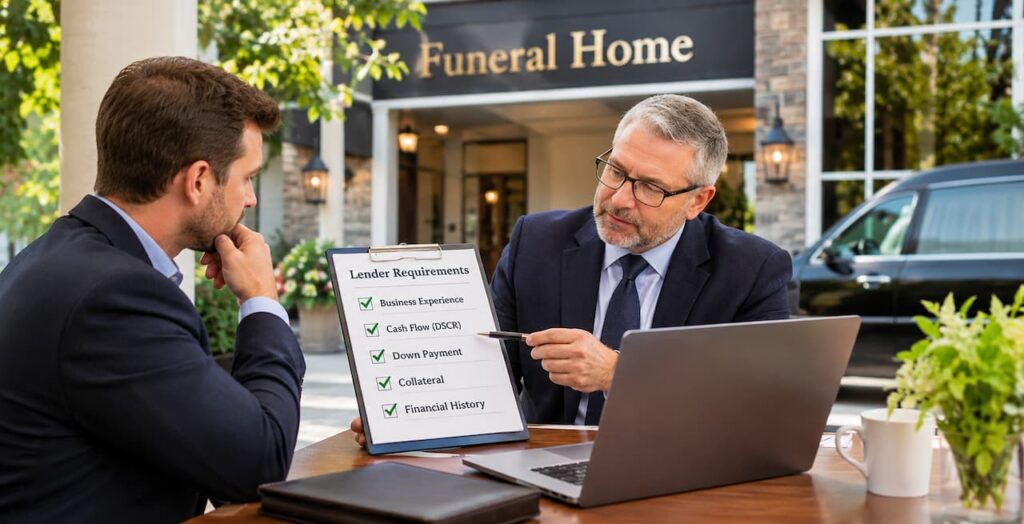
What Do Lenders Look for When Approving a Conventional Funeral Home Loan?
Cash Flow and Debt Service Coverage Ratio
Lenders need evidence that the business can comfortably meet its existing and proposed debt obligations.
One important measure is the debt service coverage ratio (DSCR):
DSCR = Cash Flow Available for Debt Service ÷ Total Debt Service
For example, a funeral home generating $300,000 in annual cash flow available for debt service with $240,000 in annual debt payments has a DSCR of 1.25.
This means the business generates $1.25 for every $1 in annual debt obligations.
Minimum DSCR requirements vary by lender and transaction. A stronger ratio can support an application but does not guarantee approval.
Read our guide to DSCR for funeral home loans.
Credit History and Financial Strength
Lenders may review personal and business credit histories, existing liabilities, liquidity, and financial statements. Strong credit can help, but business performance and repayment capacity also matter.
Down Payment and Collateral
Conventional loans may require a substantial equity contribution. Some transactions require 20% to 30% or more, depending on the lender, collateral, and borrower’s financial strength.
Collateral may include commercial real estate or other assets acceptable to the lender. The property’s value alone does not determine approval; the business must also demonstrate an ability to repay the loan.
Business Experience
An established operating history can help demonstrate financial stability. Lenders may review revenue, expenses, historical cash flow, funeral call volume, management experience, and projected performance following an acquisition.
Conventional vs SBA Funeral Home Loans
Both conventional and SBA financing can support funeral home ownership, but they have different structures and eligibility requirements.
| Factor | Conventional Loan | SBA 7(a) Loan |
| Government guarantee | No | Yes, subject to program rules |
| Down payment | Often 20%–30% or more | Equity requirements depend on the transaction; 10% is a common minimum for applicable transactions |
| Goodwill financing | Often limited | Eligible goodwill may be financed |
| Repayment terms | Depend on lender and transaction | Eligible real estate financing may qualify for terms up to 25 years |
| Underwriting | Bank-specific requirements | Lender underwriting plus SBA requirements |
| Potential fit | Borrowers with strong financials and acceptable collateral | Eligible borrowers who need greater financing flexibility |
These are general distinctions, not guaranteed terms. Actual rates, equity requirements, and repayment schedules vary.
For a more detailed comparison, read SBA vs conventional funeral home loans.
What Documents Do You Need to Apply?
Preparing your financial records can help streamline the application process. Depending on the transaction, lenders may request:
- Business tax returns and financial statements.
- Current profit-and-loss statements and balance sheets.
- Personal tax returns and financial statements.
- A schedule of existing business debts.
- Historical revenue and funeral call volume.
- Purchase agreements and proposed transaction details.
- Property valuations or appraisal reports, when applicable.
- Documentation showing the source of your down payment.
- Business plans or financial projections, where relevant.
Requirements vary depending on whether you are acquiring a business, purchasing real estate, expanding, or refinancing.
Use our funeral home loan preparation guide to organize the information you may need.
Common Mistakes to Avoid
Assuming all acquisition costs can be financed: Conventional lenders may treat goodwill differently from real estate. Confirm how each component of the purchase price will be funded.
Focusing only on the interest rate: Compare fees, down payment requirements, repayment terms, collateral, and total borrowing costs.
Overlooking working capital: Using nearly all available cash for a down payment can leave insufficient funds for payroll, maintenance, and unexpected expenses.
Ignoring cash flow: Review debt obligations and business performance before applying.
Choosing financing too early: Evaluate the entire transaction before deciding whether conventional or SBA financing is the better fit.
Frequently Asked Questions
What credit score do I need for a conventional funeral home loan?
There is no universal minimum credit score. Lenders evaluate credit history alongside business cash flow, liquidity, collateral, and the proposed transaction.
How much down payment is required?
Some conventional transactions require 20% to 30% or more in borrower equity. The actual requirement depends on the lender, business financials, collateral, and loan structure.
Can a conventional loan finance funeral home goodwill?
Some specialized financing arrangements may accommodate goodwill, but many conventional lenders limit financing for intangible assets. Confirm the lender’s policy before finalizing an acquisition.
Are conventional funeral home loans better than SBA loans?
Neither option is universally better. Conventional financing may suit established borrowers with strong financials and sufficient collateral. SBA financing may better suit eligible buyers who need to finance goodwill or benefit from longer repayment terms.
Can I use a conventional loan to refinance existing business debt?
Potentially, yes. Approval depends on the existing debt, business performance, collateral, and proposed refinancing structure.
How long does approval take?
Timelines vary by lender and transaction complexity. Complete financial records, clear purchase terms, and timely appraisals can help avoid unnecessary delays.
Find the Right Financing for Your Funeral Home
A conventional funeral home loan can help qualified buyers and established owners finance real estate, acquisitions, expansion, or refinancing. The right structure depends on your cash flow, available equity, collateral, and long-term business goals.
FuneralHomeLoan.com works directly with federally insured banks to help funeral home owners and buyers explore financing options.
Ready to discuss your financing needs? Contact FuneralHomeLoan.com to explore your options.